mostly under construction: much more to come here
Websites recommended:
http://antsofafrica.org/
http://www.antweb.org/
http://www.antwiki.org/
Papers and further reading:
Review of Anoplolepis ... and notes on Acropyga – A J Prins, Annals of the SA Museum, June 1982
http://antsofafrica.org/ant_species_2012/anoplolepis/anoplolepis/prins-1982-hns4205.pdf
Characterization of an Acropyga arnoldi mating swarm and early stage colony founding behaviour
LaPolla and Spearman, 2007
http://www.jstor.org/discover/10.2307/25078979?uid=2&uid=4&sid=21105325749723
Taxonomy of Ponerine genus Hypoponera
Bolton & Fisher, 2011
http://www.mapress.com/zootaxa/2011/f/zt02843p118.pdf
The Genus Hagensia Forel
George Arnold, May 1951
http://antsofafrica.org/ant_species_2012/pachycondyla/pachycondyla_saldanhae/arnold1951_hagensia.pdf
Friday, September 5, 2014

Ant imitators: don’t be fooled!
Ants are amongst the most successful of all insects, so it’s hardly surprising that a large number of other goggas imitate them. There are a large number of beetles, spiders and even wingless wasps that pretend to be ants. Some do it to avoid being eaten themselves [ants don’t generally taste very nice, unless you’re an ant-eater]. Others do it because they prey on ants, and by pretending to be one amongst friends they can avoid being torn apart themselves. Arthropods that mimic ants are technically known as myrmecomorphs.
Wasps and ants belong to the same order of insects [Hymenoptera] with essentially similar body-shapes, so it may not be all that surprising that there are many convincing ant-mimics amongst the wasps. However, some wingless wasps are just that, and despite the lack of wings they don’t resemble any specific ants at all. Our first subject here, however, was collected on the wall of the Oudebosch office, where we initially mistook it for an Argentine ant, so convincing was the mimicry. That said, it seems odd that a local wasp could mimic an invasive ant, so it is possibly imitating a Pheidole instead.
You can always tell wasps from ants by the antennae, if nothing else. Wasps’ antennae form a smooth curve of more-or-less equal segments on a short scape, whereas ants all have a long first segment [scape], followed by a series of shorter ones. Ant antennae thus form an L shape rather than a smooth curve.
Simon Van Noort of Iziko Museums identified this little wasp as Conophorisca littoriticus. He writes in iSpot:
This is a species of a bizarre subfamily of Pteromalidae (Chalcidoidea) that are parasitoids of a range of insects (see WaspWeb link below under comments). Biology of most genera is unknown, but curculionid beetles (Coleoptera); mantid egg cases (Mantodea); or Glossina tsetse fly puparia (Glossinidae, Diptera) are known hosts. There is a rich African fauna, with most species still undescribed.


Wasp myrmecomorphs
Wasps and ants belong to the same order of insects [Hymenoptera] with essentially similar body-shapes, so it may not be all that surprising that there are many convincing ant-mimics amongst the wasps. However, some wingless wasps are just that, and despite the lack of wings they don’t resemble any specific ants at all. Our first subject here, however, was collected on the wall of the Oudebosch office, where we initially mistook it for an Argentine ant, so convincing was the mimicry. That said, it seems odd that a local wasp could mimic an invasive ant, so it is possibly imitating a Pheidole instead.
You can always tell wasps from ants by the antennae, if nothing else. Wasps’ antennae form a smooth curve of more-or-less equal segments on a short scape, whereas ants all have a long first segment [scape], followed by a series of shorter ones. Ant antennae thus form an L shape rather than a smooth curve.
Simon Van Noort of Iziko Museums identified this little wasp as Conophorisca littoriticus. He writes in iSpot:
This is a species of a bizarre subfamily of Pteromalidae (Chalcidoidea) that are parasitoids of a range of insects (see WaspWeb link below under comments). Biology of most genera is unknown, but curculionid beetles (Coleoptera); mantid egg cases (Mantodea); or Glossina tsetse fly puparia (Glossinidae, Diptera) are known hosts. There is a rich African fauna, with most species still undescribed.
Spider myrmecomorphs
A fascinating aspect of these imitators are those impersonators – particularly spiders – that imitate ants that have long disappeared from suburban gardens in the face of invasion by Argentine ants and other aliens. The faux-ants provide us with a record of the historical ant-fauna of these areas. As time goes on we hope to build up an illustrated record of these frauds on this site; any photographs that we can draw from would be most welcome.

The ant-mimic above is Mexcala rufa [cf Tony Rebelo, iSpot]. It is a jumping spider from the sub-family Salticidae, and very accurately mimics the common Balbyter sugar ant, Camponotus fulvopilosus.

But here’s the rub: the spider hails from Muizenberg, quite the wrong habitat for this dry, hot country ant. Could the spider be a relic from a hotter, drier time in the Cape?

Beetle myrmecomorphs
 |
| Although this gogga looks very ant-like, when you look at its underside you can see very clearly that its legs are attached utterly differently from those of an ant. Remember, too, that the first segment of the antennae of all ants is an elongated ‘stalk’. |
 |
| Another ant-imitator [awaiting ID] – its movements are uncannily ant-like |
 |
| Very similar to the above and probably the opposite sex of the same gogga, they’ve been identified as belonging to an undescribed genus of the sub-family Korynetinae |
 |
| Here’s a wonderful conundrum; this undescribed, unnamed myrmecomorph is probably from the sub-family Anthicidae [Riaan Stals, pers comm] and it not only imitates ants, it seems to imitate the Korynetinae beetles above. Or is the Korynetine imitating the Anthicide? Anthicide or Korynetine? Who knows? |
 |
| This tiny fellow seems to imitate Lepisiota ants; we are waiting for a name for him. (or her?) |
Under construction
Contact us
Please don’t hesitate to contact us through this contact address: http://www.slingsbymaps.com/contactus.aspx . Please forgive the complication, but putting an email address up on site is too risky.
For the record: where they've been found
PONERINAE
Bothroponera pumicosa: the Rugged ringbum ant

Found at:
Oudebos; Cape Point
PSEUDOMYRMICINAE
Tetraponera clypeata: the Black slender ant
 Found at:
Silvermine, Lakeside, Kleinmond
DORYLINAE
under construction
DOLICHODERINAE
Linepithema humile: the Argentine ant
 Found at:
Lakeside, Calvinia, Kleinmond, Ceres [town and mountainside]; Oudebos, Nieuwoudtville, Red Hill, Rondebosch, Marina da Gama, Zandvlei, Stanford, Hermanus, Muizenberg, Marina da Gama
Technomyrmex albipes: the White-footed ant

Bothroponera pumicosa: the Rugged ringbum ant
Found at:
Oudebos; Cape Point
PSEUDOMYRMICINAE
Tetraponera clypeata: the Black slender ant
Silvermine, Lakeside, Kleinmond
DORYLINAE
under construction
DOLICHODERINAE
Linepithema humile: the Argentine ant
Found at: Lakeside, Calvinia, Kleinmond, Ceres [town and mountainside]; Oudebos, Nieuwoudtville, Red Hill, Rondebosch, Marina da Gama, Zandvlei, Stanford, Hermanus, Muizenberg, Marina da Gama
Technomyrmex albipes: the White-footed ant
Found at:
Lakeside, Waterfalls Cottage near Stanford, GrootvadersboschAbout Us
I was fifteen when a perceptive uncle gave me a copy of Skaife’s ‘The Study of Ants’. I was quite a nerdy teenager and IT hadn’t been invented yet, so in no time at all I had colonies of restless goggas installed in the box-room under the stairs. I tried most of the species that Skaife recommended, but giant Spotted Sugar ants (Camponotus maculatus) were my favourite. A year or so later I was physically (but certainly not spiritually) nabbed by the SADF, and sent off to Pretoria to learn how to play cards in between mindless marching. The ants had to go; and I was privileged to have my ants accepted by the great Skaife himself, giving me the opportunity to spend days in his lab at Tierboskloof, in Hout Bay, before the khakis got me.
Twenty years later everything that Skaife had taught me became crucially important when, with William Bond, we discovered the importance of myrmecochory [ant distribution of seeds] in fynbos ecology. Sometimes being an amateur works well, and I do not heed the advice of the scruffy old Prof who commented that you can’t rely on amateurs to ID ants. The taxonomy of many genera, especially Pheidole and Camponotus, is in such a mess that you can’t, apparently, rely on the academics either.
That said, whether amateur or professional, your inputs towards mapping the poorly-known distribution of our ant species, especially the invaders who threaten the ecology of much of the fynbos, will be of huge value. Merely recording a few key ant species when you are resting during a hike, taking a lunch break, or chasing ants out of the kitchen of your holiday house will help provide key data that we simply do not have at present. Please feel free to comment freely on this site, or contact us through http://www.slingsbymaps.com/contactus.aspx .
– Peter Slingsby, Zandvlei

Twenty years later everything that Skaife had taught me became crucially important when, with William Bond, we discovered the importance of myrmecochory [ant distribution of seeds] in fynbos ecology. Sometimes being an amateur works well, and I do not heed the advice of the scruffy old Prof who commented that you can’t rely on amateurs to ID ants. The taxonomy of many genera, especially Pheidole and Camponotus, is in such a mess that you can’t, apparently, rely on the academics either.
That said, whether amateur or professional, your inputs towards mapping the poorly-known distribution of our ant species, especially the invaders who threaten the ecology of much of the fynbos, will be of huge value. Merely recording a few key ant species when you are resting during a hike, taking a lunch break, or chasing ants out of the kitchen of your holiday house will help provide key data that we simply do not have at present. Please feel free to comment freely on this site, or contact us through http://www.slingsbymaps.com/contactus.aspx .
– Peter Slingsby, Zandvlei
Tuesday, August 26, 2014
under construction
UNDER CONSTRUCTION
 |
| 1. Argentine ants, Linepithema humile, specimens from Lakeside. Also collected at Calvinia, Kleinmond, Ceres [mountainside]; Oudebos, Nieuwoudtville, Red Hill, Rondebosch, Marina da Gama, Zandvlei, Stanford, Hermanus etc etc |

 |
| 2. White-footed ant [I presume], Technomyrmex albipes [could be T. pallipes?] Collected from Lakeside. Also collected at Waterfalls Cottage near Stanford. |

 |
| 3. Brown house ants, Pheidole capensis or P. megacephala, specimens from Oudebos, also collected at Silvermine, Tokai, Agter-Pakhuis (Sevilla), Tankwa Karoo, Sutherland, Nieuwoudtville, Ceres, Biedouw Valley |

 |
| 4. Small black sugar ant, Lepisiota capensis, specimen from Sevilla. Also collected at Oudebos, Bordjiesrif [Cape Point], Doordrift Constantia, Tokai, Mount Nelson Hotel, Rooisand Kleinmond. |

 |
| 5. Balbyter ant, Camponotus fulvopilosus. Specimen from Tankwa Karoo. Also collected at Sutherland, Sevilla, Kokerboomwoud Nieuwoudtville, Biedouw, Doringbos and near Calvinia |

 |
| 6. Spotted sugar ants, Camponotus maculatus, specimens from Sevilla. Also collected at Silvermine and Kleinmond. |

 |
| 7. Hairy sugar ant, Camponotus niveosetosus, specimen from Oudebos. Also collected at Tsitsikamma [?], Stanford |
 |
| 8. Large black sugar ant, Camponotus werthi, collected at Lakeside [!]. It may have come with plants from Kirstenbosch nursery. |
 |
| 9. Large pugnacious ant, Anoplolepis custodiens, collected at Ceres near caravan park. Curiously, I have not yet found it elsewhere. |
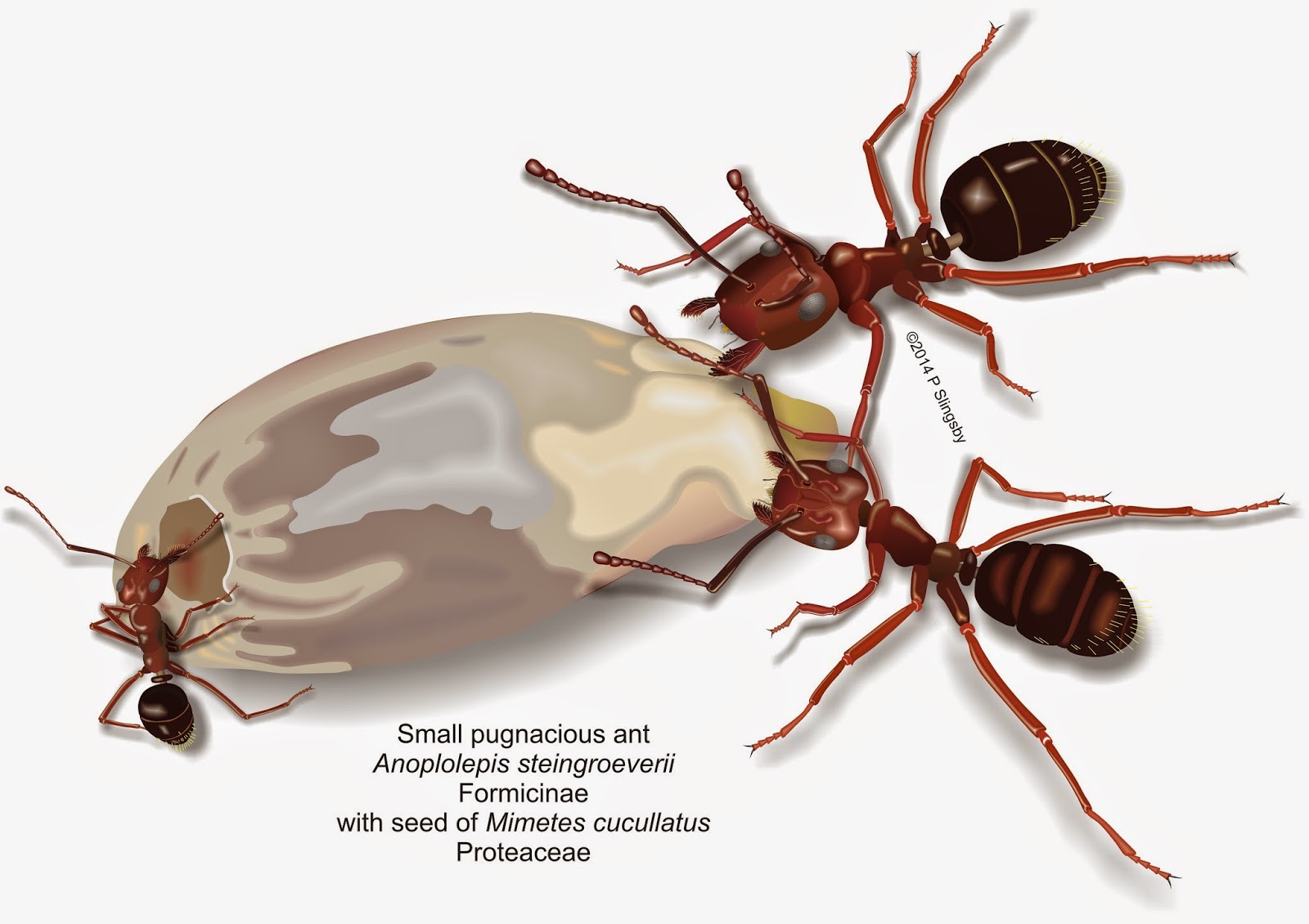 |
| 10. Small pugnacious ant, Anoplolepis steingroeverii, specimens from Oudebos. Also collected at Sevilla, Ceres, Tankwa Karoo, Biedouw, Doring River, Kleinmond Rooisand, Betty's Bay, Silvermine, Cape Point, Red Hill, Stanford Waterfalls |
 |
| 11. Black feigning ant, Tetramorium sp [?], collected at Sevilla. Curls up and feigns death when touched. Common at Sevilla, seems to be a harvester. About 4mm long and heavier set than T. quadrispinosum; black but could almost be confused with a Pheidole major [which it definitely isn't!] More info anyone? |
 |
| 12. Black garden ant, Tetramorium quadrspinosum, collected at Oudebos. Also at Sevilla. |

 |
| 13. Hotrod ant, Ocymyrmex barbiger, collected [upper pic] at Sevilla [where they are surprisingly common] and Oudebos [lower pic]. Also collected in the Roggeveld north of Sutherland. |

 |
| 14. Drop-tail ant, Myrmicaria nigra, collected at Silvermine. Also at Ceres. |
 |
| 15. Cocktail ant, Crematogaster peringueyi, collected at Cape Point. Also at Red Hill, Kleinmond, Oudebos, Sevilla, Vlakkenberg, Stanford Waterfalls |
 |
| 16. Harvester ants, Messor capensis, specimens from Sevilla. Also collected at Tankwa Karoo and Hantam Botanical Garden at Nieuwoudtville. |
 |
| 17. Small yellow ant, Monomorium modestum [?], specimen from Cape Point. Also at Waterfalls, Stanford, and Oudebos. |
 |
| 18. Slender ant, Tetraponera clypeata, specimen from Lakeside! -- possibly on plants brought from Kirstenbosch nursery. Also collected at Silvermine and Kleinmond. |
 |
| 19. Red driver ant major, Dorylus helvolus. Collected at Kleinmond. Not yet encountered elsewhere. |
All illustrations ©Peter Slingsby
Subscribe to:
Posts (Atom)